![Solar Charge Controller 20A 12V/24V PWM]()
![Solar Charge Controller 30A 12V/24V/36V/48V MPPT with Bluetooth]()
![Solar Charge Controller 40A 12V/24V/36V/48V MPPT with Bluetooth]() See details
See detailsSolar Charge Controller 40A 12V/24V/36V/48V MPPT with Bluetooth
$299.00Unit price /UnavailableLow stock![VoltX SRNE 12V/24V 30A MPPT Solar Charge Controller]()
![VoltX SRNE 12V/24V 60A MPPT Solar Charge Controller]()
![VoltX SRNE 12V/24V 20A MPPT Solar Charge Controller]()
![VoltX SRNE 12V/24V 40A MPPT Solar Charge Controller]()
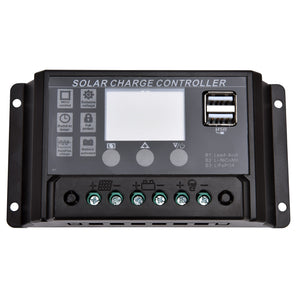
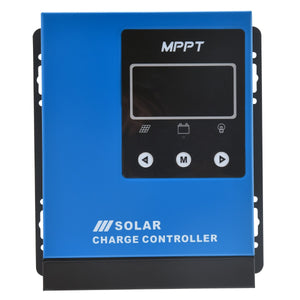
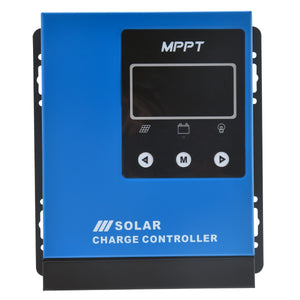
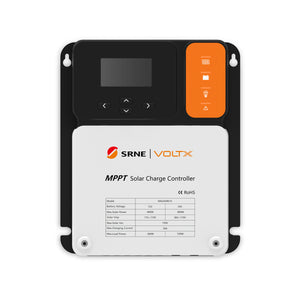
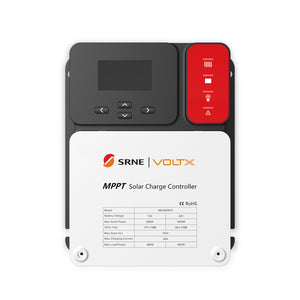
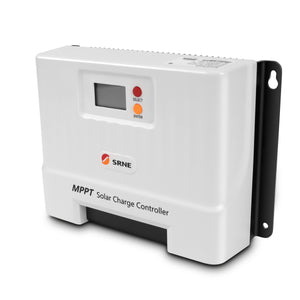
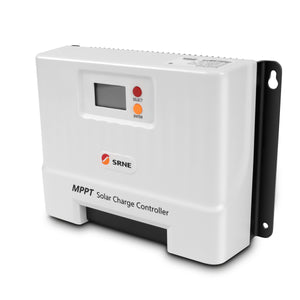
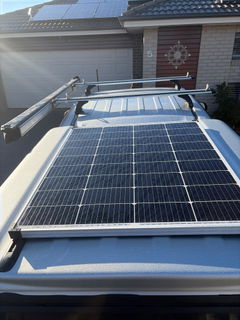
A good solar panel installation would always have a solar charge controller. Sometimes referred to as a solar regulator, this device comes in a compact form yet plays a crucial role in the use of solar energy. It's a must-have, whether you're using panels to power your home or have them fitted on your RV roof.
What does a solar charge controller do? Simply put, its main job is to regulate the energy generated by your panels which will eventually flow into your battery for storage. Here's a little breakdown of all its functions to highlight why you need it in your system.
Read more: How to Use Solar to Stay Off-Grid
Overload Protection
As mentioned earlier, a regulator helps control the current flowing in your battery pack and keeps it within the circuit limit to keep your system from overloading, increasing the risk of fires.
Over-discharge Prevention
A solar controller also automatically disconnects non-critical loads from your battery pack if the voltage falls below the recommended level to help prevent over-discharge.
Avoids Reverse Currents
Solar panels supply current through your battery in a single direction, which can be reversed especially at night and cause a discharge. Your charge controller blocks this by serving as a valve.
Now, on to one more question: Are solar charge controllers required all the time? In most cases, yes. The only exception to this would be if you're using 1-5 solar panel watts mainly for charging smaller devices such as mobile phones. Anything beyond this requires a regulator for optimal use, whether you’re using fixed solar panels, flexible solar panels, or solar mats.
If you're searching for a good solar charge controller, check out our range at Outbax. We have a variety of models here including popular regulator types plus other solar panel accessories you might need for installation and maintenance.
What Are The Types Of Solar Charge Controllers?
Regulators are divided into two main types: the Maximum Power Point Tracking or MPPT solar charge controller and the Pulse Width Modulation or PWM solar charge controller. These are both used widely and have around 15 years of service life. Each one also has certain applications that they're more suited for.
Let's have a closer look at both types for a quick guide on which one to use for your power needs.
PWM Solar Charge Controllers
PWM regulators are popular since they're the cheaper type. At around $20 to $60, you can get yourself one of these. This type of controller regulates the energy flow to the battery by gradually reducing current and providing continuous, short charging pulses to your power pack.
A PWM solar charge controller is great for smaller systems like RVs and tiny homes as these require the solar panel and battery to have matching voltages.
MPPT Solar Charge Controllers
Known as the more efficient solar charge controller, MPPT regulators cost around $100 to $730. With this, the current is drawn out of the solar panel at maximum voltage yet the output is limited to ensure the battery doesn't get overcharged.
Since the output of your panels varies due to changing weather conditions, there will always be a specific voltage that will give you the best output during operation. An MPPT controller ensures that it follows the most optimal power output.
For example, during a cloudy day, it will decrease the amount of current drawn from the solar panel and increase it once it becomes sunny again to maintain a desirable output.
An MPPT regulator is also great for larger systems like bigger homes and cabins, or those living in colder locations.
What Size of Solar Charge Controller Do I Need?
In order to determine the correct solar charge controller size, divide the watts of your solar array by the voltage of your battery bank. For instance, if you have a 1000W solar array and a 24V battery, your regulator should at least be 40A.
There is also a concept that allows you to "over-panel" your controller, which refers to putting in a higher wattage than what your controller is rated for. This will allow your solar array to increase output throughout the day and clip it once it reaches peak output to limit the rating to 40A.
Another possibility is to undersize your array so your regulator is not working in full rating the entire day, thus, prolonging its life. If you're considering either of the two, talk to your provider for expert advice on which one will work best for you.
Buy High-Quality Solar Charge Controllers At Outbax
At Outbax, we have a selection of highly efficient PWM and MPPT solar charge controllers for all kinds of solar power systems. Whether you're after a standard 12V solar charge controller or a higher voltage level, we got you covered.
Check out one of our best items, the 12V/24V 40A MPPT Regulator with LCD. Boasting a 99% tracking efficiency, it ensures maximum power point solar charging to get more energy into your battery bank. This is not limited to your 100Ah lithium battery either as you can use it for gel, AGM, and flooded lead-acid batteries as well.
Our PWM controllers are just as impressive. It features a PWM 3-stage charging process - bulk, absorption, and float stage for rapid, intelligent, and safe battery charging. This one is also equipped with an LCD display, providing you with a real-time view of the input, output, and battery status.
More From Outbax
Start your solar journey with Outbax. Aside from solar charge controllers, we also have a range of premium LiFePO4 batteries in different capacities. Pair them with our monocrystalline solar panels and Pure Sine Wave inverters and you’re ready to reap the benefits of using solar energy soon!
Are you more into portable power at the moment? We have awesome choices for you too. Check out our award-winning inverter generators and world-class power stations. These are your best mates for camping, road trips, or even a sudden power outage when you’re in the middle of working!
Visit our website today and browse through the finest gear at never-before prices!
Frequently Asked Questions
- What are the best solar panels to buy for a home?
- Can I run my whole house on solar power?
- How long do solar panels last?
- What is the difference between a hybrid inverter and a regular inverter?
- Do I need a battery for my home solar system?
- What maintenance do home solar systems require?
- Can I install a home solar system myself?
- How does a solar system work on cloudy days?
- What is an MPPT charge controller?
- What are portable solar panels used for?
- How do I choose the right size portable solar panel?
- What's the difference between a solar panel kit and a solar blanket?
- Do I need an Anderson plug for a portable solar panel?
- Are these solar panels waterproof?